
If all you ever do is go camping, or I should say glamping, with a full portable kitchen setup you don’t know what it really takes to cook food in the wild. I mean cooking using the primitive techniques that our ancestors have used since time immemorial.

Maybe you just want to travel light. Maybe you’re in the middle of a bona fide survival situation and have no other choice. Whatever the reason, whatever the location or situation, knowing how to prepare safe, nutritious, and hopefully tasty food using primitive techniques can save your life and make the circumstances a little more bearable.
It might sound elementary, but I promise you there are tons of nuances you need to know to avoid screwing up. Happily, I’m bringing you a guide that will tell you everything you need to know about primitive cooking so you can do it right. Roll up your sleeves and let’s dig in.
Primitive Cooking Methods
If you imagine a campfire, or in this case a cook fire, when you hear the term primitive cooking, you aren’t alone. But you should know that roasting is only one technique out of many, and you are wise to master at least a few and preferably all of them.
Below are the primitive cooking techniques that smart preppers will add to their repertoires.
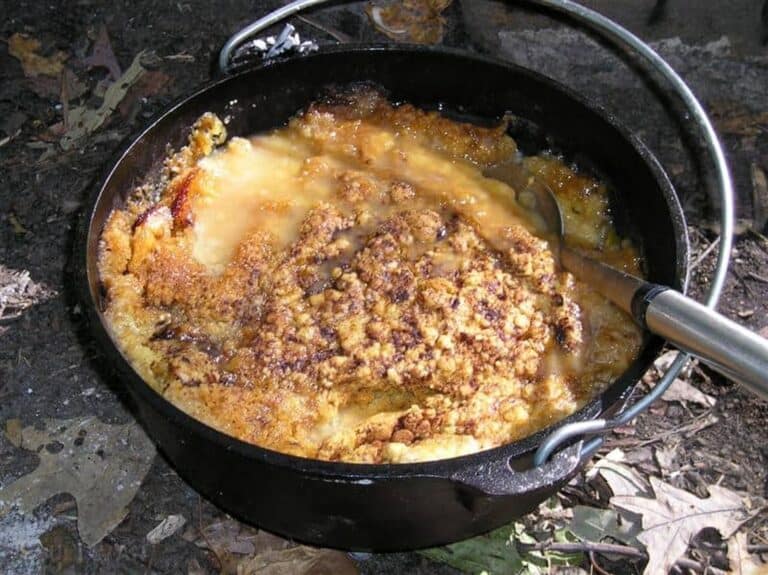
Open Fire
This is the first, most obvious, and most versatile primitive cooking technique. Mankind has been roasting, grilling, and spitting food over an open fire since well before recorded history was even a thing. And there are lots of good reasons for that!
Most foods can be suitably or at least safely prepared over an open fire with very little setup. If you can arrange a lattice of sticks to hold it, set up a rotisserie arrangement, or just hold skewered food near the fire, it will soon be cooked and ready to eat with very little extra effort. Meat and veggies are both great candidates for cooking over an open fire.
Cooking directly over the fire provides intense heat, charring, and quick cook times, or you can position food near and adjacent to the flames to take advantage of radiant heat for slower but more even cooking. That variation is ideal for larger cuts of meat or delicate foods like fish and veggies.
The trick to success with cooking over an open fire is in building the fire itself and controlling it for easy and efficient management of the process. It’s simple, but not easy!
Also, your approach will be limited by what resources you have on hand: you won’t be grilling if you don’t have a portable grill grate or if you can’t lash together a grate made out of green sticks and twigs.
Hot Stone
Hot stone cooking is exactly what it sounds like: using a heated, flat stone as a cooking surface. The process is quite similar to using a griddle or pan at home on your stovetop.
An appropriately sized stone can be collected, cleaned, and then heated directly in or very near the fire until it is the appropriate temperature, then food is placed directly on it.
And you don’t need to worry about germs, either: none can survive sustained exposure to intense heat, to say nothing of an open flame!
Using a stone in this way gives you more control over the process, reduces the risk of food being burned up or lost in the fire, and makes it easier to manage different foods cooking at the same time.

Obviously, you’ll need utensils to move the food around while it’s cooking, even if it’s just a couple of sticks for the purpose.
You’ve also got to take care to choose the right kind of rock for the job: sandstone or basalt is ideal because they won’t crack or fracture even when extremely hot, but if you use a river rock or some other kind of stone that is saturated with moisture, it can actually explode with dangerous results!
Ash / Coals
Cooking directly in ash or coals after a fire has died down is a great way to gently cook all kinds of vegetables and smaller cuts of meat, as well as get as much cooking done as possible with a given amount of fuel.

The process is simple. Once the fire has burned down to a bed of hot coals and ashes, all you need to do is rake them into a thick layer or a small mound.
Food, whatever it is, is then traditionally wrapped in leaves or, in some cultures, in clay or sturdy containers and then buried in the coals. This provides thorough, 360-degree, and even cooking.

Most of the time, you will only need to turn or rotate the food once, assuming the ashes are hot enough to begin with. Seasoned outdoorsmen will collect hot coals and ashes from a primary cooking fire and transfer them to the pile or layer to maintain consistent heat.
Getting the most from this method requires experience, and the only way to do that is to actually practice for yourself. One thing to watch out for is ash contamination if your food isn’t properly wrapped or sealed; it won’t necessarily hurt you, but it will definitely hurt the taste!
Steam Pit
A cooking technique that has been employed around the world by many different cultures is steaming, specifically through the use of a steam pit.
It’s just what you think; trapping steam cooks food gently but thoroughly and increases moisture content, something that can get the most out of vegetables and delicate meats like poultry or fish.
However, this can be a time- and sometimes labor-intensive method. Properly steaming food using the minimum amount of fuel requires a small pit to be dug in the ground and wet vegetation to produce the steam itself. Typically, a pit that is 24 to 36 inches deep is enough, depending on the quantity of food.

A fire will be built in the pit, which is then lined with flat stones. Wet vegetation is then laid on top of the stones, producing the steam, and then the food is laid on top of that before the circular ring of stones and vegetation is buried.
The fire can be maintained to keep the steam flowing or allowed to die down, depending on what’s being cooked.
There’s a lot that can go wrong with this method: wet ground can put out the fire, or rising water levels can snuff the whole thing. Food may be safely cooked, but it could end up too soggy and unpalatable. Checking food for doneness is tricky and risks steam burns.
Smoking
Smoking isn’t just the star attraction of your next cookout! Smoking adds tons of flavor, yes, but it’s also one of the best primitive methodologies for actually preserving the food that you cook. The smoking process drives moisture out of food, moisture that would contribute greatly to spoilage.
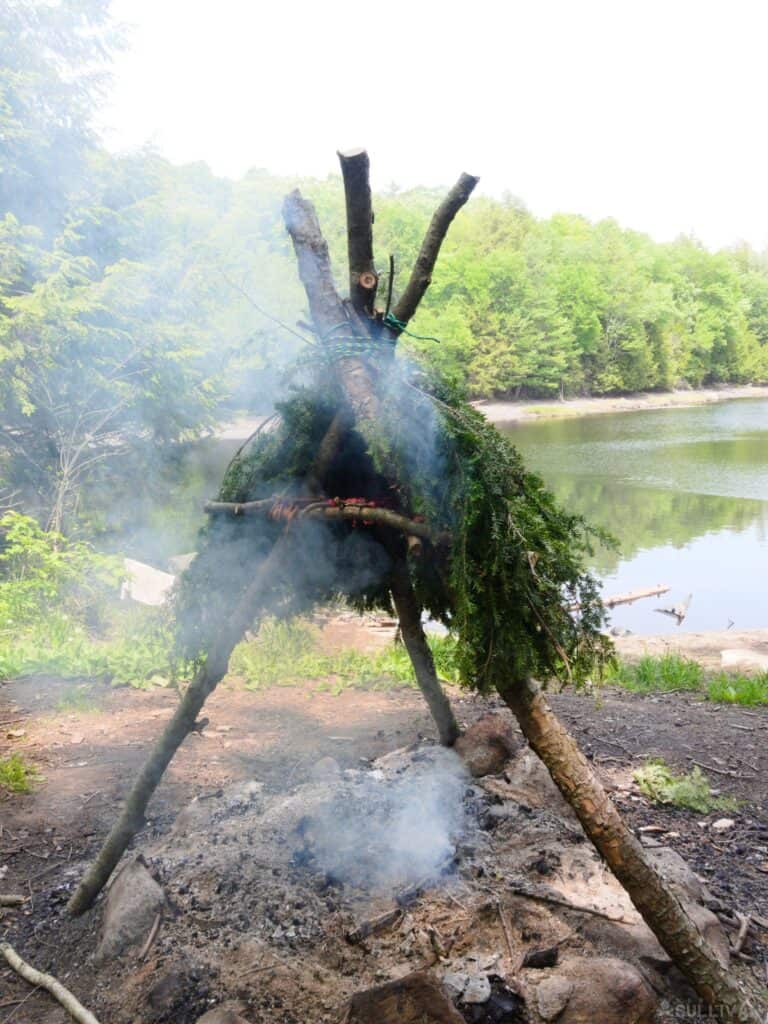
All you need to smoke food properly in the wild is a tipi or tripod-like structure enclosed by leafy branches. This structure is placed over a low, smoky fire, and the food inside the smoker is given sufficient time to fully dry out.
Depending on what you’re cooking and whether you’re going with a hot smoke or cold smoke approach, this could take anywhere from 8 hours to 2 days.
Just like using a modern smoker, the challenge with this approach is controlling the temperature and the amount of smoke generated. Soaking the firewood so it will produce more smoke more consistently is key, as is choosing the right wood.
You must avoid wood with a high resin content and young, green wood. Attending and properly ventilating the fire to prevent it from “flaring up” or going out is paramount.
Stone Boiling
Another technique that relies on stones, stone boiling is used when you don’t want to keep a pot or other container full of water directly over the fire for whatever reason. Some containers aren’t fireproof, after all!
As expected, all you need to do is heat up several small stones and then drop them into your container of water or broth.

You can add stones gradually to increase the temperature to a simmer, or drop in a bunch at once to get a hard boil going quickly. More stones can be added to maintain the temperature for cooking grains, pasta, and the like or just keeping a batch of stew or soup hot.
The trick here is retrieving the stones: tongs work best, but if you don’t have those, you’ll have to try to fish them out using sticks, a spoon, or something similar.
Cookware or No Cookware? That is the Question
Disclosure: This post has links to 3rd party websites, so I may get a commission if you buy through those links. Survival Sullivan is a participant in the Amazon Services LLC Associates Program. As an Amazon Associate, I earn from qualifying purchases. See my full disclosure for more.
And it’s a question that can dictate your approach! If you’re fortunate enough to have even a partial mess kit with you, you’ll get a lot more mileage out of primitive cooking techniques for a lot less effort. Having heat-proof pots, pans, Dutch ovens, utensils, and more will greatly expedite your efforts and save you time.
For my part, I go with a half-and-half approach. I use all of the methodologies detailed above, so I don’t have to carry stoves, fuel, griddles, grates, and the like along with me as part of my bug-out bag, but having the containers and utensils, especially tongs and long-handled spoons, is a lifesaver.
That said, it’s possible to start with nothing, absolute zero, and still use these techniques to good effect. Branches and planks of wood can be used to make everything you need if you are handy with a knife and cordage. Just take care that you choose green wood for this specifically because its higher moisture content makes it less likely to burn!
Principles of Primitive Cooking
No matter which of the previously discussed methods you choose or which one you rely on the most, there are principles that apply to all of them.
Mastering these principles will pave the way for your success, no matter the method.
Manage Your Fuel Supply
This is so, so important. Depending on where you are, depending on the situation, you might have a seemingly limitless fuel supply, or it might be truly scarce.
Accordingly, don’t treat this like you are cooking on your stovetop at home with gas or electricity. Fuel is precious, and you should act like it. Set yourself up for success and prep your food so you can get it cooking as quickly as possible and get as much “work” done as possible with the fuel you use.
As mentioned above, you can maximize your return by cooking in the coals and ashes that burn down and heating rocks simultaneously that can be used for boiling or for supplementary cooking.
Heat Control
The single biggest hurdle that preppers have to clear with primitive cooking techniques is learning how to control heat. Believe me, it’s not like turning a knob on your stovetop, oven, or camping stove!
Different kinds of wood generate different amounts of heat. The amount of heat they generate also differs depending on how seasoned the wood is. Oak, hickory, and other hardwoods tend to be quite hot compared to softwoods like pine.
The way that you shape or construct the fire also makes a difference. Generally, a square or pyramid shape is good for cooking. Another technique for controlling heat is to make a zone fire, with a hotter side and a cooler side. This is sort of similar to what you can do with a backyard gas or charcoal grill.
Safety
Safety is always paramount when cooking, and that counts doubly for primitive cooking. Fires can get out of control and spread. Steam can burn you, and hot rocks can blister you in an instant. Food that is undercooked can give you food poisoning, and that can be disastrous or even deadly if you’re already in a bad situation.
You might have bigger problems, but pay attention to proper food handling practices, too. If you prepare raw food on a piece of bark or wood, don’t put your cooked food back on it.
Never harvest leaves, wood, bark, or anything else from plants that might be dangerous or from ones that are growing in areas that are possibly contaminated by chemicals or anything else.
If you have them, wear gloves to help protect your hands and always keep sand or water nearby, if possible, to quickly douse a fire that gets out of control.
I urge you, in the strongest possible terms, to prioritize safety.
Tips, Tricks and Other Considerations
- Learn how to handle bad weather. You can build windbreaks using a tarp, branches, stones or even soil to help you keep better control over your fire and accordingly you’re cooking.
- Study history. Specifically, study and learn from various tribal and indigenous cultures around the world as it pertains to cooking. There’s tons of wisdom out there that is still just as valuable today.
- Employ good deterrent practices in wildlife areas. Rodents, insects and larger, dangerous animals like bears and feral dogs will be attracted by the smell. Plan accordingly.
- Simpler is better. Learn how to make your food palatable and edible with as little effort as possible. Simple seasoning and basic preparation should be your go-to, not sophisticated TikTok-worthy backwoods banquets. This is about survival, not clout and not entertainment.


Tom Marlowe practically grew up with a gun in his hand, and has held all kinds of jobs in the gun industry: range safety, sales, instruction and consulting, Tom has the experience to help civilian shooters figure out what will work best for them.