
Pretty much everyone knows by now that trees contain sap. If you’ve ever chopped wood before, or just cut into a tree for any other purpose, you’ve probably noticed this clear, viscous fluid leaking out.

Even if you haven’t, I have little doubt that you’re already well aware of maple syrup, both how delicious it is and where it comes from.
Again, it comes from sap! But have you ever stopped to wonder precisely what sap is? What exactly is tree sap, anyway?
Tree sap is a fluid that circulates through a tree carrying water, sugar, minerals, and other nutrients. It basically plays the role of blood for a tree and other plants.
Even though it doesn’t work as quickly or as obviously as one for animals, trees basically have a circulatory system that you recognize the same as any other, and for much the same purposes…
In this role, it is sap that plays the part of blood, basically a carrier fluid that moves sugar nutrients and even gasses in the form of oxygen and carbon dioxide around the tree’s tissues.
Sap is truly fascinating stuff, and is useful for all sorts of things. Keep reading, and I’ll tell you more about it.
What is Tree Sap Made Of?
Sap is primarily made up of water, which facilitates the movement of other components.
But a significant fraction of sap is sugar, specifically sucrose, fructose, and glucose, all of which provide energy for the tree’s growth and development.
Sap also has various minerals that trees need for different functions, such as calcium, potassium, and magnesium among others.
Sap also carries gasses in the same way that blood does, with oxygen and carbon dioxide both being involved in photosynthesis and respiration.
And that isn’t all: Amino acids present in the sap act as building blocks for a tree’s biology, each contributing to the tree’s overall health and resilience.
Hormones are also carried by sap, regulating the tree’s growth.
All of these components are essential for the tree’s structural integrity and metabolic activities, and each of these components plays a distinct role.
What Else Does Tree Sap Do for the Tree?
So we learned that the sap of a tree is its literal lifeblood, playing multiple roles in its biology.
Aside from directly moving nutrients and moisture around the sometimes massive body of the tree, sap also plays a crucial role in photosynthesis.
The sugars in the sap, produced in the leaves, serve as energy sources for this process, enabling the tree to convert sunlight directly into food.
Furthermore, the sap provides some defense against pests and diseases.
When a tree is injured, the sap (and sometimes resin) oozes out and hardens, creating a sort of scab or bandage that helps protect the tree from infection.
The sap of most trees even has natural but potent antimicrobial properties, providing additional protection.
Is Tree Sap the Same Thing as Tree Resin?
No. While tree sap and tree resin are often used interchangeably in casual conversation among us normal folk, botanists and arborists would tell you that you are wrong!
Sap and resin aren’t the same thing as each has distinct functions: Tree sap is a fluid that circulates through a tree’s vascular system, carrying water and nutrients.
But tree resin is a thicker, even more viscous substance primarily produced by coniferous trees.
Unlike sap, which flows freely within and throughout the tree, resin is typically stored in specialized structures called ducts, and is only exuded when the tree is seriously wounded, most times.
Resin serves a strongly protective function, literally capping off injuries and stopping insects and pathogens cold.
Its chemical composition is also very different from sap, having complex compounds like terpenes and phenolics.
Do All Trees Have Sap?
Yes, all trees have some form of sap, as it’s an essential component of their life as I discussed above.
However, not all trees produce sap that is useful or accessible to humans.
And quite the contrary; the sap of many other tree species is neither palatable nor easily extractable!
Therefore, while all trees have and need their sap, its utility for people varies widely depending on the species.
Is Tree Sap Useful?
Often, yes! Tree sap serves a diverse array of uses for people, too, not just the tree. Some saps are truly multi-purpose, particularly those from pine, birch, and maple trees.
Pine sap is rich in terpenes, making it a great natural adhesive and sealant. It’s also used in producing turpentine, a solvent for oil-based paints and varnishes.
Birch sap can be made into a refreshing drink packed with vitamins and minerals, and also be fermented into wine.
And as for maple sap, you already know how precious this stuff is! It’s the primary ingredient in the ever-delicious maple syrup.
So, whether it’s for culinary, or utility purposes, tree sap can indeed be incredibly useful.
How Is Tree Sap Collected?
Collecting tree sap, a process known as tapping, typically involves drilling a hole into the trunk of a suitable tree and inserting a spout.
The sap flows out of the tree, passes through the spout and drops into a bucket or sometimes a special bag. This traditional method is often used to collect maple and birch sap.
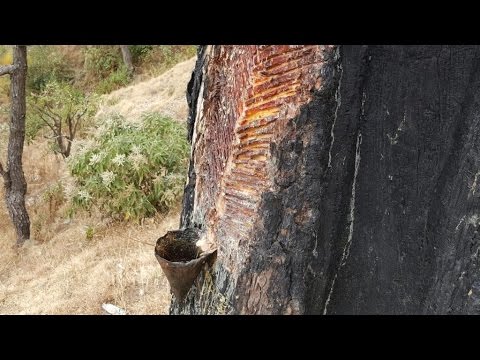
For pine sap, it naturally exudes when the tree is wounded even slightly, and can be scraped off the bark.
Field expedient methods for collecting sap involve creating a downward cut or “V” shape into the tree, allowing the sap to trickle down and then be collected at the point of the notch.
Even today, these methods are generally low-tech and can be done with basic tools (even manual tools!), making sap collection accessible even in remote or austere settings.
Edibility
Ok, so some people assert that tree sap is actually edible, too. Is it true? How about pine sap? Can you safely eat pine sap?
No, pine sap is not safe to eat as-is. It has high concentrations of terpenes, which will cause serious digestive upset and, at high concentrations, can be poisonous. It can also contain bacteria that might cause food poisoning.
Regrettably, pine sap is just not safe to eat, though it can be processed and used later as an ingredient. And, take it from your author here, the stuff is pretty repulsive. If you nibble a little bit yourself, I bet any amount of money you’d spit it out in an instant.
Risks
There aren’t really major risks associated with eating pine sap, even though you shouldn’t. It contains varying levels of terpenes, compounds which serve as biological building blocks in plants.
These compounds can be harmful if ingested in significant quantities; plants and insects use them as organic components in various defensive mechanisms. That should tell you everything you need to know!
If you force yourself to eat pine sap, you’ll get an upset stomach pretty quickly, and that usually means diarrhea.
That’s something you can’t afford in a survival situation where dehydration or loss of electrolytes could spell disaster. In some cases, it can cause inflammation of the intestines or stomach ulcers if you eat a lot of it.
Potentially a bigger concern is the presence of bacteria that could be in the sap, or could contaminate it during collection or handling. There are all sorts of nasty microbes out in the wild that can make you dreadfully ill or, potentially, kill you.
Yes, that’s always a risk when collecting wild edibles in a survival situation, but I think it’d be pretty dumb to come down with something nasty trying to collect and eat pine sap, which won’t keep you alive anyway.
I Thought People Used to Chew Pine Sap as Gum?
You are quite right. Pine sap can be processed into a kind of gum, and various cultures around the world throughout history have chewed pine sap as a sort of oral cleanser.
It can definitely freshen your breath, but it tastes extremely harsh. If you stick with it, and keep spitting because it will make you salivate, eventually it’ll mellow out and turn into a vaguely gum-like consistency that can be chewed for a while for pleasure or to help clean your teeth.
American Indians did it and it likely taught the earliest European settlers to do the same. I’ll warn you, though, it’s quite an experience and you shouldn’t swallow it! Also, be very careful if you have fillings or any broken or damaged teeth. This stuff can be ferociously sticky and tough.
Is Sap from Other Trees Edible?
Yes, some are! Although you’ll always have to contend with the potential presence of bacteria, which could be problematic, the sap from maple and birch trees is directly edible with no processing, although there is still the potential to get an upset stomach if you eat too much.
Both types of sap are subtly sweet and contain various nutrients that can help keep your body running.
Note that if you have any way to collect it and then heat it to kill bacteria, you should do that. This will also help to eliminate certain compounds which contribute to indigestion.
You don’t need to process it into syrup or anything; it takes a very long time and has a conversion rate of about 100 to 1, so you won’t be wasting your time in the wild!
Can Tree Sap be Dangerous?
Yes, some saps are highly dangerous to human and animal life!
While many tree saps have beneficial uses, certain trees produce sap that can be harmful to humans at best or deadly at worst.
Perhaps the most notorious example is the manchineel tree, so much so that it is often referred to as the “world’s most dangerous tree”. The sap of this deadly beuaty with tiny, appealing fruits contains phorbol, a supremely potent skin irritant.
Even trace contact with this sap can cause severe dermatitis and blistering, and even blindness if it reaches the eyes. Ingestion is often fatal.
Yew trees are another good, or rather bad, example. Although its sap isn’t as immediately harmful as the manchineel’s, all parts of the yew tree, including the sap, contain taxine, an alkaloid poison.
These compounds are highly toxic if ingested or potentially if they come into contact with the skin alone, leading to symptoms like dizziness, nausea, and in severe cases, heart failure.
Many tree saps are considered beneficial, but it’s critical to know which trees are safe and which are not.
Never, ever try to make use of any sap from a tree you haven’t positively identified!

Tom Marlowe practically grew up with a gun in his hand, and has held all kinds of jobs in the gun industry: range safety, sales, instruction and consulting, Tom has the experience to help civilian shooters figure out what will work best for them.