
The difference between a survivor and a statistic isn’t measured in gear. It’s measured in know-how! Understanding how to make the best possible use of any and all resources available to you in the environment will make the difference between life and death, no matter the situation or the environment…

The good news is that, unless you’re in the middle of the Sahara or Antarctica, most places will furnish plenty of useful materials and other supplies. Case in point and the subject of this article: the humble, ubiquitous pine cone!
Far more than a festive decoration, pine cones can supply critical shelter materials, light, heat, and more. Keep reading, and I’ll tell you about five proven ways to use pine cones in a survival situation.
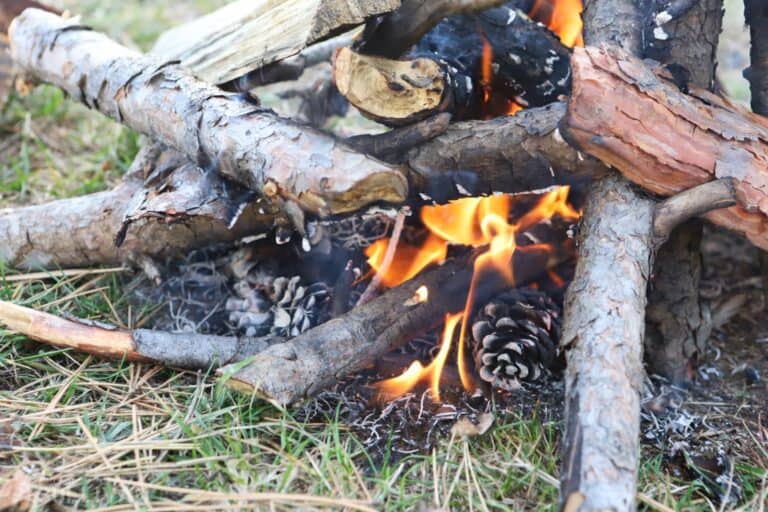
As Fire Starters
An oldie but a goodie, and one that every prepper needs to know about. Pine cones (and pine wood in general) are one of the very best fire starters you can get as long as they are dry.
Once they mature and open up, releasing their payload of seeds, they are very flammable. This is because of their shape, the woody material they are made from, and the high concentration of flammable resin they contain.
Pine cones can be used as is for tinder or kindling, depending on the size of the fire you are starting, or crushed into smaller pieces for better control or to stretch your supply.
If you want a frugal and effective survival project, one that’s perfect for doing with your kids, you can collect pine cones, bring them home, and turn them into long-lasting, portable fire starters with a little bit of candle wax. I like to do this with small pine cones because they are the perfect size for my camping kit and bug-out bag.

As Torches
Carrying on with the usefulness of pine cones for starting fires, they make the perfect topper for an improvised torch. Yes, they burn well on their own, but where they really excel is as a holder for additional fuel in the form of resin-soaked strips of cloth, dried grass, or anything else you can cram in between the “petals” of the pine cone.
The trick is mounting the pine cone to the branch. You can try tying it on with sinew or heavy leather in a pinch, but I’ve found that a better way to go is to split a stout branch into quarters at one end and then wedge the pine cone in between the staves. This will hold it securely even as your fuel starts to burn away.
I also like to wrap a strip of cloth or other material around the midsection of the torch to help protect my hand from any dripping resin. It’s really easy to whip up a batch of torches quickly using pine cones in this way, so be sure to keep this technique in your survival bag of tricks.

As Insulation
Rough, pokey pine cones are probably the last thing you’d reach for if you need insulation, but used smartly, they can work wonders…
Whether you’re making a lean-to, a ground cover, a primitive mattress, or any other kind of wilderness shelter, you can use pine cones to bulk up or thicken what you are making. This assumes, of course, you can collect enough of them.
Here we made an improvised bed but we made sure the blanket was thick – plus we fold it in half for extra thickness (and comfort):
If you are gathering pine boughs, dried grass, leaves, and whatnot along with pine cones, you can lay down or lash together a layer of the former before putting down a layer of pine cones and then finishing up with a second layer of boughs and leaves.
This creates a kind of composite insulation that is highly effective at trapping warm air and blocking wind, or if you are making a mattress, you’ll find it makes a really comfortable one!
With a little bit of practice, you’ll find that pine cones are highly adaptable to many wilderness survival projects of this kind.

As Trail Markers
The only people who think woodland navigation is easy and foolproof are those who have never left the campground. I can guarantee you they’ve never attempted it at night.
There are lots of methods for marking your trail or leaving “breadcrumbs” for yourself on your forays, sticks and rocks being two of the most popular, but in the past several years, I’ve taken to using pine cones for the purpose.
Think about it: pine cones are very light, they have a distinct shape, and they are easily stacked. It requires a lot less energy to gather and carry them compared to rocks, and unlike laying sticks on the ground, they stick up prominently and are easier to see no matter what direction you are viewing them from.
My go-to technique for using them in this way is to build a little pyramid out of them, basically the same way you would use rocks as a trail or camp marker.
Scraping out a shallow depression, easily done any number of ways, will give this structure a bit more stability. The only downside with this technique is that they are a bit more vulnerable to being blown over in strong winds, so do keep that in mind.

As Food
I saved the best for last because I know a bunch of people just won’t believe it. But I swear, it’s true! You can eat pine cones. Rather, I should say pine cones have edible parts. Nobody wants to chow down on a woody, crusty cone, and that isn’t what we are going to eat.
Immature pine cones contain the seeds of the tree, commonly called pine nuts, that can be extracted. They are a wonderful source of vitamins, minerals, healthy fats, and calories. Believe it or not, young and flexible cones can also be boiled and then eaten.
Alternately, you can use a plastic bag or something similar to harvest the copious amounts of yellow pine pollen from pine cones. It can be used as a thickener for soups and stews or similar to flour.
Of course, there is a major caveat to eating pine cones: you must be absolutely sure you are eating from a safe variety of tree! Mistaking an edible variety like a red pine, western white pine, or slash pine for a ponderosa or lodgepole pine, or worse, a yew tree, could see you wind up deathly ill or even dead.
All the rules for identifying, harvesting, and consuming wild edibles apply to pine cones, so make sure you brush up on your wild foods lore before committing to this course of action.

Tom Marlowe practically grew up with a gun in his hand, and has held all kinds of jobs in the gun industry: range safety, sales, instruction and consulting, Tom has the experience to help civilian shooters figure out what will work best for them.