
Defending your home and property is thought of as a fundamental American right. And it is, but despite that, laws, and lots of them, still apply. It is your responsibility to stay within the law so that you can avoid a negative outcome if you are forced to defend yourself, your family, home, and property.
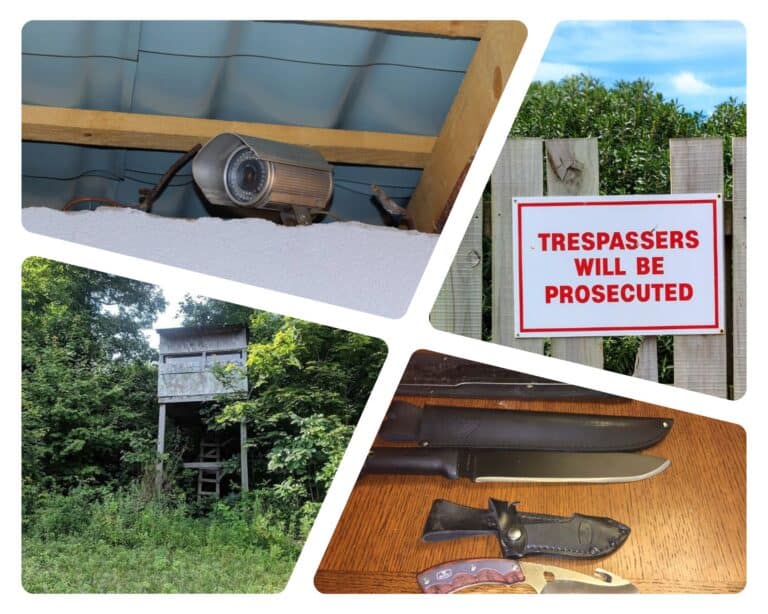
This is not just for city dwellers: folks who want to live way out in the country, well away from cities, must still obey all applicable county and state laws regarding the many facets of self-defense. This is not something you can afford to take lightly. If you aren’t justified in the eyes of the law, you could be facing a lengthy prison sentence and monumental financial damage.
You do not want that to happen, and I don’t want it to happen to you. Ignorance is no excuse, especially in the litigious country we live in today. Keep reading and I will give you a primer on all the must-know legal aspects of defending your rural home.
Disclaimer before we start: this is not legal advice, but rather, a really basic overview of what to expect when you go through US laws. For specialized legal advice, hire an attorney.
Table of Contents
Use of Force Basics
The very first thing to understand regarding self-defense, any kind of self-defense, in your home or out, in the city or in the country, is that your use of force against a threat must be proportional and reasonable. This is not a very clear-cut concept to some, so let me give you some examples…
If someone were to throw water in your face, let’s say spray you with a water hose, would it be okay for you to haul off and shoot them? No, of course not. If someone pushes you, merely pushes you, is it okay to pull out a knife and stab them? Generally not.
The easiest way to think of this is that you are allowed to meet force, or a given threat, with a similar and proportional level of force, and even then, only use enough force to neutralize or drive off the threat.
As a rule of thumb, from coast to coast and in every state, lethal force is only justified in response to an immediate and apparent risk of death or great bodily injury to you or another. In some states, the use of defensive lethal force is justified in response to any forcible felony.
And yes, this applies even if you are on your own property. Just because someone walks onto your property and uses force against you does not mean lethal force is now prudent and justified in response. Again, refer back to the examples I gave above.
No matter the reason, you have to keep your head on this stuff or you can lose your freedom.
Fundamental Self-Defense Law Variations – “Stand Your Ground” vs. “Duty to Retreat”
Another important aspect of self-defense laws that apply everywhere, including for folks living in the country, is a fundamental difference in how states structure their statutes.
Broadly, states will have what are popularly referred to as stand-your-ground laws or duty to retreat laws.
These are rarely codified with exactly these terms in the statutes themselves, but are used conceptually to describe the net effects of the laws for defenders.
Stand-your-ground laws generally mean that any person who has a legal, lawful right to be where they are may use force, including lethal force, in response to a threat without any legal obligation to try and get away first.
Happily, this is the most common interpretation of self-defense laws across the United States. Some states with stand-your-ground type laws include Kentucky, Tennessee, Georgia, Florida, Texas, and Arizona.
Duty to retreat laws, as you would expect, entail a legal responsibility for a defender to attempt retreat from a threat if it is possible prior to using force in defense, especially lethal force. This gets tricky for defenders because it is a jury or a judge who will look at the circumstances and make a decision on whether or not you had enough time to get away from the machete-wielding psychopath before you shot him.
States with duty to retreat laws include New York, New Jersey, Rhode Island, and Hawaii.
A thorough overview of each state’s laws in this regard is beyond the confines of this primer, but lucky for you, I have written a whole series of state-by-state guides on exactly that topic. Check out the link for more.
Castle Doctrine
Castle doctrine laws can be thought of as a subset of stand-your-ground laws. In short, these laws specify, typically, that regardless of the standards for defense outside the home, a person has no obligation whatsoever to attempt retreat when inside their home or other legally occupied domicile, usually including things like RVs and campers, motor vehicles, and rented accommodations. Sometimes the domicile definition is extended to the curtilage, or edge, of the property itself.
Most states that have castle doctrine laws also specify that any activity that attempts forcible or surreptitious entry into an occupied domicile is itself considered a forcible felony and may be met with lethal force from the outset.
For folks who care about property rights and self-defense in the increasingly uncertain country we live in, you want to live in a state that has stand-your-ground and castle doctrine laws.
Firearm Regulations
Owning a gun and living in the country is basically synonymous as a concept. If you are going to be totally self-sufficient, you had better have a gun, right?
Right, except that not all states feel the same way about this concept, Constitution be damned. There are hundreds and hundreds of firearms regulations on the books at the federal and state level across the country, and it is your responsibility to know and obey every single one of them.
There are laws covering purchasing, how many you can own, what types you can own, the calibers you can use, how many cartridges a given firearm can hold, how they must be stored, and a whole lot more.
If you are in doubt, just head to a local gun shop in your area and they will get you up to speed. Even so, you are wise to look up all the relevant state statutes yourself. As expected, some states are a lot worse than others: Washington, California, New York, New Jersey, and Illinois are particularly odious, while most states across the South and Southwest are far more permissive.
Another general, and I emphasize general, rule of thumb is that you are allowed to keep a gun on your person when you are on your property, whether it is concealed or openly carried. But even this varies from state to state.
Do not assume anything. If you have a large property, you might think it is as natural as anything to keep a handgun on your hip or a rifle in your side-by-side for dealing with pests that pop up as you go around fixing fences and doing chores, but it might not be.
Warning Shots
On the subject of firearms use, we need to tackle one notion that I have seen pop up year after year, like a bad rash:
Warning shots. Bottom line up front: never, ever do them.
I don’t care what you think, and I don’t care what you heard or from whom. Warning shots are a very bad idea.
As to why, it is all about the laws of the land. Almost without exception, the use of a firearm, defensively or otherwise, is considered lethal force. Merely pointing a gun, loaded or not, at someone entails multiple felonies if it is not done in the context of justifiable self-defense. Discharging the gun in a threatening manner, whether or not the bullet strikes or harms anyone, is a whole other level.
Here’s the point: the only time you should discharge your firearm at another person in a defensive context is when you are absolutely certain that you must shoot someone to stop the threat they pose to you or your family. That is it.
Giving a trespasser a warning shot or doing so to intimidate someone who is lurking on your property or has trespassed makes you the bad guy in the eyes of the law, and that is almost everywhere.
No warning shots of any kind for any purpose, ever.
Defensive Weapons Beyond Guns
Guns are not the end-all, be-all defensive implement. For some people, and for whatever reason, other tools take the top spot or serve as secondary or supplementary weapons.
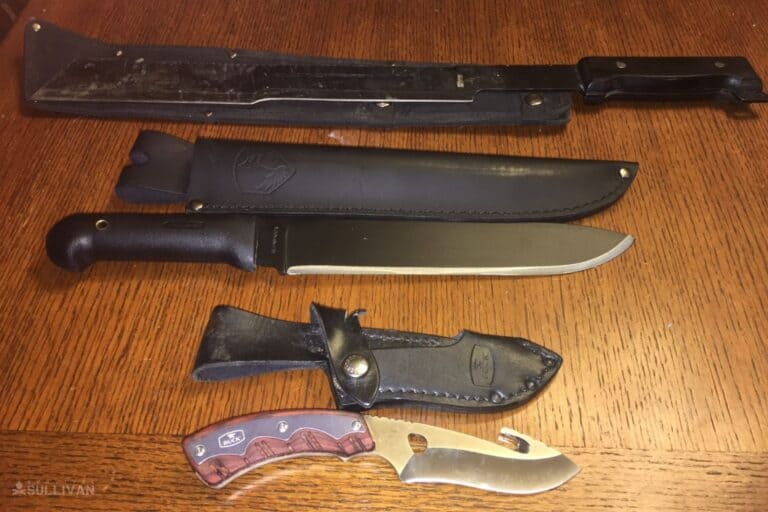
In most states, things like clubs and knives are legal, though every state has its own eccentricities regarding type. Some states allow small, flexible clubs like blackjacks and saps, but others do not.
Knives, likewise, tend to be stringently regulated whether or not you are in your home or on your property. Knives with blades over a certain length, double-edged knives, and automatic knives, so-called switchblades, are among the most regulated types, as are swords in some cases.
Then you have electric weapons like stun guns and tasers. Despite being on the belts of just about every police officer in the nation, most states have seen fit to regulate these items for civilians.
All can fit into your defensive plan or serve specific roles for yourself or members of your family. Just make sure you check the laws on each before you commit.
Trespassing Laws
This is the single biggest issue for most rural residents, and in my experience, it is also the most emotional and potentially the most dangerous for us in a legal sense.
Trespassing laws vary considerably from state to state, but again, as a general rule, trespassing, even crossing over a fence, wall, or other barrier, is not considered a forcible felony. Trespassing alone does not constitute a threat to yourself or others. That means you cannot shoot or use force against someone who is merely trespassing.
What you should do is call the police and have the person trespassed, if at all possible. This is the smartest response that will get you the best outcome.
“No Trespassing” Signs
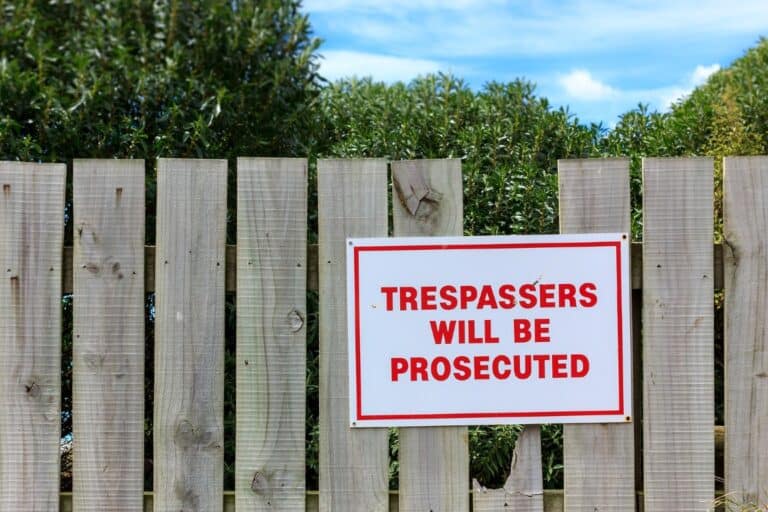
Something else to consider on the topic of trespassing: much of the time, in many states, you must have posted signage or painted marks to enforce the law against people who trespass on your land.
Lacking the proper signage or marks, when the time comes to press charges, you might not be able to move forward with the strongest possible charges, or you might not be able to charge at all.
One thing that will catch up with lots of rural property owners is posting requirements. You will need to put signs or marks at minimum intervals around your property, and you may need to include your name and address on the signs as well.
A good rule of thumb, though, is to always post “no trespassing” signs if you don’t want any unexpected visitors poking around.
Defensive Structures
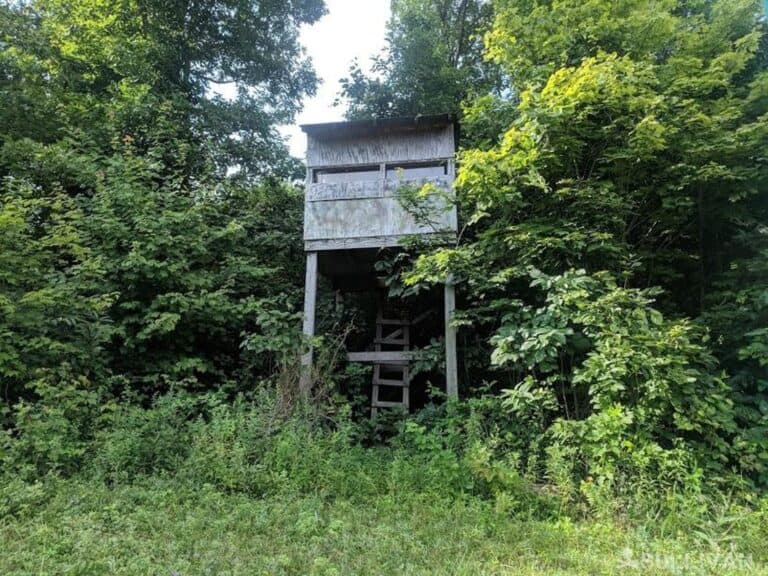
If you have livestock on your property, you will need a fence of some kind, be it solid or electric. Even if you do not have animals, you might want a fence or wall, and maybe a healthy amount of barbed wire, to keep unwanted guests away.
Fair enough, but once again, just because America is called the land of the free doesn’t mean you are free to do what you want, no matter how common sense the idea might be. Even on rural properties, even for undeveloped land and unincorporated communities, there are plenty of laws that apply to the type, construction, placement, and other factors of all kinds of fencing and barriers.
For starters, you do not want to get this wrong and then be forced to tear everything down or relocate it. That will be expensive and certainly aggravating. Regarding defense, particularly, the addition of things like barbed or razor wire, spikes, or electricity might not be legal for those purposes or in certain contexts.
Once again, the most critical piece of advice I will give you throughout this guide: check your county and state laws, and understand them, before you act.
Booby Traps
If you have watched any amount of westerns, post-apocalyptic survival stories, or thrillers involving deranged survivalists, you have probably seen booby traps in action, specifically for use against people.
Let me skip to the end. In every single state, booby traps that can inflict harm on people, used for the purpose of or allowed through negligence or omission to inflict harm on people, are absolutely illegal.
You cannot protect your home, your property, or the boundary of your property with booby traps of any kind, period. The only exceptions, such as they are, are obstacles like barbed and razor wire where otherwise allowed by law, and noise-making or visual indicator type alarms that can alert you to the presence of a person.
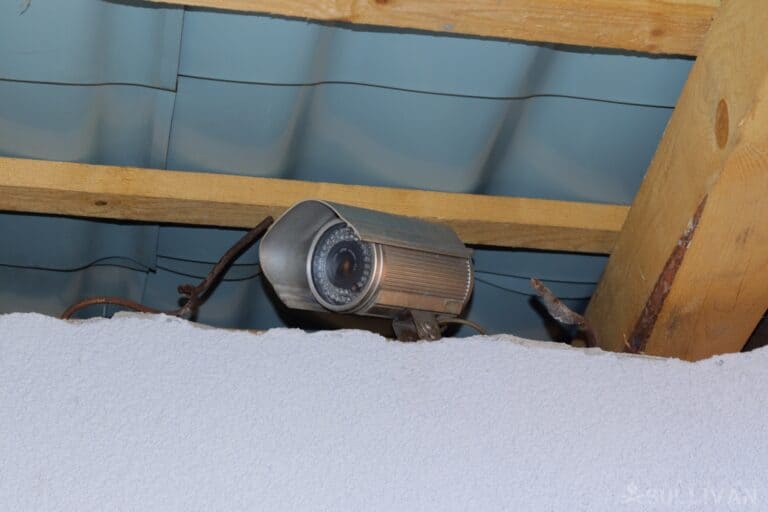
Home Surveillance
One of the very best things you can do to improve your home security posture, wherever you live, is to install a network of surveillance cameras in strategic spots.
This is an entirely separate subject unto itself, and I have covered the nuts and bolts in other articles (here and here), but for this one you simply need to know that there are some legal considerations.
Recording your own property is, almost invariably, completely legal. Things get tricky when you start recording other people’s property, or parts thereof, even if this happens incidentally because you are recording your own.
This usually is not an issue if the area being recorded is visible from a publicly accessible place, but some states, like Florida and Delaware, have Peeping Tom laws that impose strict penalties for making recordings of any private property where a person has a reasonable expectation of privacy. Take care if your security cameras can see into the windows of a neighbor’s property.
Strangely enough, the recording of audio conversations is even more restrictive than recording video, and many states, like California and Florida, have “all-party” consent mandates.
Militia or Vigilante Groups
It’s not something that comes up for most, but think twice before you join any militia or vigilante group that promises mutual aid to one another in case of home invasion, trespass, and so on.
While most state laws featuring stand-your-ground or castle doctrine statutes make allowances for one person to intervene with force, including lethal force, when it is appropriate on behalf of another, this is a seriously complicated factor in most self-defense cases.
Practically, unless it is your neighbor within earshot or someone else who is in the home or on the property with you, most people will not be able to reach you in a relevant amount of time during an actual threat.
If, after the threat has passed, the people riding to the rescue were to catch up to those individuals and instigate a confrontation, now we are dealing with an entirely separate event that could be illegal in its own right.
It’s good to look out for your neighbors. It is good to take care of each other. But unless you are living in a post-collapse America, joining a militia or similar group for purposes of a mutual defense pact is not going to help your situation.
Law Enforcement Response Times
If you have time and opportunity, you are always advised to call the police when you think trouble is brewing or there is a threat against you. At the very least, making a report and getting on the phone with a 911 dispatcher will make you look like what you are, which is the victim of a violent crime.
However, if you live way out in the country, you should be under no illusions that a cop will be right around the corner when you need them most. Chances are they will not be, and that means it is up to you to protect yourself.
Even so, after any use of defensive force, even if it is non-lethal, you must contact the police as quickly as possible to make a report. Consider that the other party, liars that they are, might do the same and paint you as the aggressor. It has happened before.
In any case, if you wait or decide not to do so, you could face separate charges. There is a duty to report in some places.
Civil Liability
The sad fact of the matter is that even if you are cleared of all criminal charges at the scene of a defensive incident, it’s highly likely that you will still face civil charges. These civil charges will entail weeks or months of grinding litigation and drain you of money.
That career criminal burglar and rapist that you shot breaking into your house was, in reality, someone’s poor, sweet baby boy who did no wrong, always got good grades in school, sang in the choir, and had a NASA scholarship. The criminal themselves, or their survivors, can and likely will sue you.
Happily, not quite half the states in the Union feature statutory laws that prevent civil litigation against defenders if they are cleared of the relevant criminal charges in a self-defense case. Arizona, Arkansas, Alabama, and Florida are just a few of them.
This, more than most other things on this list, is something you should think long and hard about before you commit to where to live. In many states, frivolous civil litigation is allowed in the aftermath of these self-defense cases because the process itself is a punishment and deterrent against other citizens doing the same. The state, as always, jealously guards its monopoly on righteous violence.
Defending Livestock and Property
If you raise livestock to make a living, taking care of those animals and protecting them is synonymous with protecting your own financial well-being.
Wildlife, in the form of predators great and small, and also people who might steal your animals, are two threats you will have to defend against…
When it comes to protecting against wildlife, you are generally allowed to dispatch threatening animals that could endanger your own. Things get a little stickier if you’re dealing with a protected species, like mountain lions and certain birds of prey. Some states, like Tennessee, allow you to deal with these animals yourself, making exceptions for threats against livestock and people.
Generally, if the threat is a person, you cannot use lethal force to stop theft of livestock. There are very rare exceptions to this, like Texas, which has a niche law that allows the use of lethal force to stop the imminent commission of a theft during hours of darkness.
Defense Against Wildlife
In short, no animal, no matter how valuable or legally protected, is worth a human life, and the laws of our nation reflect this. Any wildlife, even protected wildlife, that represents a clear and present danger to a human may be engaged with lethal force in defense of life.
However, you are still completely responsible for what happens during that encounter. If you are using a gun to protect yourself or someone else, it is you who is responsible for where every single bullet lands. No exceptions, no excuses.

Animal Trapping
Trapping laws vary widely from state to state. Most animals that are a nuisance, even if they are otherwise protected, may be humanely trapped and relocated or even killed using a lethal trap.
For instance, California treats skunks as protected non-game animals under most circumstances unless they are causing damage or being a nuisance on private property, in which case a person may trap them and remove them without a permit.
Some states, like Tennessee, require permits for trapping certain types of animals or employing certain types of traps. You already know what I am going to say next: research the laws of your state before you buy or set any traps for anything bigger than a mouse or rat.
Interacting with Police
Do a quick search on the internet and you will find endless advice on what you should or should not say to responding police officers in the immediate aftermath of a defensive incident. You should listen to some of these people, like legendary gun writer and expert witness Massad Ayoob.
There are three basic schools of thought here:
The first is that you should say absolutely nothing until your lawyer is present. That’s because anything and everything you say can and will be used against you.
The second is that you should give only the most basic outline of what transpired and then wait for your lawyer. Tell them who you are, that you are the victim, you were attacked by that person or those people over there, you had to use force to protect yourself and or your family, and that is that.
The third school of thought is that you should answer all of the police’s questions, being honest, open, and helpful.
My opinion is that you should follow option number two. You want the police to record what you say regarding what actually transpired, then politely tell them you want to wait for your counsel.
Here is the truth of the matter: the police are not your friends. When they show up, chances are they are going to arrest you and forward everything you say, under arrest and on the most stressful day of your entire life, to a prosecutor. That prosecutor will, very likely, bring charges and you’ll have to have all this out in a court of law at tremendous expense.
This is why it is so important for you to retain the services of a competent attorney skilled in defending victims in cases of justifiable homicide, AKA self-defense. See the next section.
Last But Not Least: Legal Counsel Preparedness
One of the single most important parts of any self-defense plan, including rural home defense, is having a good attorney on tap. Being arrested and waiting for your phone call is not the time for you to start looking up attorneys at 2:00 in the morning. Likewise you sure as hell don’t want to take your chances with a public defender.
Take the time now to get references and start filtering attorneys in your area or available through your network if you have concealed carry or self-defense insurance until you find one you have a good report with. Talk through your concerns with them, develop a plan and follow their advice.
Notably a good local attorney will understand who the players are in your legal system, the outcomes of past, similar cases to yours, and other factors that simply cannot be accounted for by advice like this. Neglect this necessity at your own peril!

Tom Marlowe practically grew up with a gun in his hand, and has held all kinds of jobs in the gun industry: range safety, sales, instruction and consulting, Tom has the experience to help civilian shooters figure out what will work best for them.
And make sure you hire a known criminal defense attorney, not your neighbors cousin who does wills and divorces.